You're receiving Creator Economy for free—but there's a lot more you get as a full subscriber, including access to our exclusive features on venture capital, creators, social media companies and more. Subscribe to The Information here for 25% off your first year (normally $399).
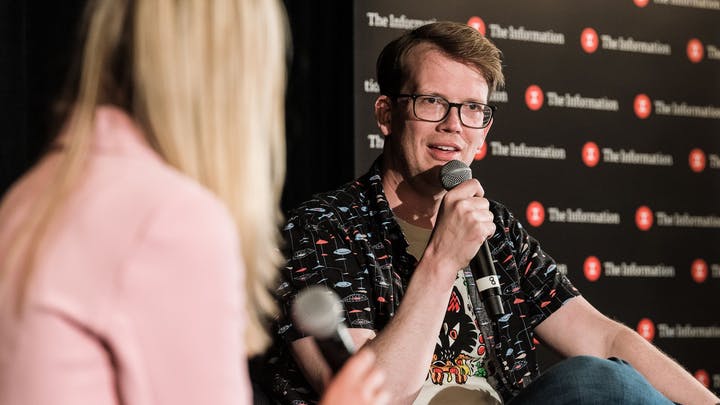
Hank Green. Photo by Erin Beach
Welcome back!
I'm still buzzing with excitement from our Creator Economy Summit last week in Los Angeles.
One of my favorite conversations of the day was with Hank Green, a longtime YouTube creator who also has 7.5 million followers on TikTok. We covered a lot of ground, from Montana's threatened TikTok ban to Twitter checkmarks to an argument with his vlogger-author brother John Green about selling VidCon, the creator conference they co-founded and sold to Paramount.
The quick version: Like many of the creators I've spoken to over the last few months, Green sounded torn about a potential TikTok ban—and TikTok in general. In his eyes, TikTok has given rise to a vibrant culture that short-form rivals Instagram Reels and YouTube Shorts couldn't replace. "A social media platform is not computer code. It is the culture that is created there," Green said.
But there's a downside. TikTok's algorithm, which can make little-known creators internet famous, means the platform doesn't need to earn their loyalty, he said. "For TikTok it means they don't have to care very much about creators…because you can give a 22-year-old attention and they will make content in exchange for a while," he said. They'll burn out, but "there's as far as I can tell, an infinite number of 22-year-olds."
And though Green is based in Montana, which is on its way to becoming the first state to ban TikTok, he's turned down the app's entreaties to stump for it. The geopolitics are just too complicated. "We are in a pickle, is how I feel about it."
He had a lot more to say, so we decided to run the interview, edited for length and clarity, here, followed by our daily rundown of news. (A video of the full interview will be available for subscribers soon.)
You uploaded your first video to YouTube in 2007. What's been the biggest change since then?
Oh, that it matters! There was no money to make, there was no status to gain. And now there is, and that means that people care and that's great and terrible and makes it hard, but also good. I'm glad that people can make money on YouTube now. I'm glad that it's a career that matters. Back when I started, every single YouTuber I would talk to wanted to do something else. They wanted it to be their springboard to something else. And now people see other platforms as springboards to YouTube.
Now you have a TikTok account with 7.5 million followers.
I do. I'm a TikToker.
So where are you spending more of your time?
The house (laughs). I use TikTok a lot. I probably watch an equal amount of TikTok and YouTube. Very different circumstances why. I'll watch two-hour long YouTube videos. It's weird. Like suddenly I will just watch a person talk for two hours. I will watch, in the same period of time, probably 400 individual TikToks.
Do you feel a stronger connection to the YouTube videos or TikTok videos that you watch?
Oh, of course, YouTube. And also [videos] that I make: I feel much more connected to my YouTube audience than my TikTok audience. I think that's very much the case for people who do both. A subscription matters on YouTube a lot more than it matters on TikTok.
Do you think short-form video is a fad or is this here to stay?
Certainly not a fad. There are cultural parts of it that are fads and we've already seen some of them come and go. Like there was that period of time where the [video] transitions kept getting better. People kept getting better and better at transitions. And then it got so good that you couldn't get any better at it. And now it's like, well, that's not a thing anymore … These things play out so fast. The new genre creation and destruction is wild.
Do you think that's good or bad?
It's neutral. It's a very creatively productive time and that's fun. But it also has negative parts where creators can go through this sort of whole life cycle of their career in six months.
What are the implications of that?
Well, for TikTok it means they don't have to care very much about creators. I'm sorry to the TikTok [employees] in the audience. I'm not saying that you don't [care], I'm saying that you don't have to because you can give a 22-year-old attention and they will make content in exchange for a while, and then eventually that's not filling up the cup anymore and you burn out because there's no next thing unless you can figure out some other thing to fill the cup. 'Cause eventually you find that the empty hole doesn't get filled up, and then you're like, well, but I would like to be able to buy lunch. So is there gonna be money? And it's like, no, there's not, so you stop making as much content and some other 22-year-old is perfectly happy to take the attention for six months and then they burn through that one. And then, there's as far as I can tell, an infinite number of 22-year-olds.
Let's talk about the economics of short-form video. You've been very outspoken about the TikTok Creator Fund in particular. Is this a TikTok problem or is this a short-form video problem that it's hard to monetize?
It's both. I've not seen TikTok's [profit & loss statement], but if you'd like to show me it, I'll totally take a look and I will let that inform my communications henceforth. If you're just counting RPM [ad revenue per thousand impressions] then it's always gonna be lower on TikTok because there's gonna be fewer ads per video. Like, there's only maybe a minute of content max, like on average. So you're not gonna have as many minutes. And then you have the problem of the format of the ad cannot be unswipeable. That would be an unacceptable user experience problem.
We haven't figured out the right ad formats. We haven't figured out how valuable it is. We haven't figured out the best ways to do it, and that problem is solvable and the CPMs will go up because of that.
Do you think the elements of what makes a video good have changed in the past decade?
You have to be so aware of a platform when you are making content. You can't be a good TikToker, unless you are a TikTok viewer. You can't be a good YouTuber, unless you watch a lot of YouTube. And that changes a lot. When I first started on TikTok, I could kind of get away with being, you know, old science guy [who] doesn't know what he's doing. And now it's three years in and I have 7 million followers and I can't play that act anymore. Creation is always a radical act of empathy. You're trying to understand how people are going to understand you.
You are based in Montana, which is the first state that has decided to move forward with wanting to ban TikTok.
Correct. There's not like a list, but I think I have the most TikTok followers of anyone in Montana. So you might expect that the TikTok people have been in touch about that.
They haven't?
No they have. They're like, 'Do you want to talk to anyone about this? We'll give you access to every person.' And I'm like, 'I kind of don't.'
So do you not want to lobby for TikTok? Because they did have a lot of creators come to Washington D.C. to lobby.
No, I can't lobby for TikTok.
Why's that?
I don't feel good about it.
Why's that?
I don't understand and will not understand the intricacies of the set of problems involved in international relations between the United States and China.
Why not?
Great question. 'Cause I'm a f—ing biochemist.
I lost my Twitter checkmark today.
Yeah, me too.
Do you care?
What a day we're having! Definitely the bigger story of today is BuzzFeed News shutting down, [and] the Insider layoffs are a bigger piece of news than a thing that had already been robbed of its value not existing for some people anymore. [Twitter's verified badge] just wasn't anything anymore. It already didn't have the value that it once provided, which was pretty simple and straightforward. And I understand that we are humans and we turn everything into a status simple if we can. And that was uncomfortable. And also Elon Musk doesn't like journalists and he's like, 'Why would we give credibility and value to journalists when they're mean to me?'
I am 100% in favor of Twitter trying to figure out other monetization systems. Twitter is a textbook ad-supported business to me. And I'm not saying it's easy. I think it's a tricky business. You can't run an ad-supported business and be constantly the character of the day.
Do you think YouTube has fended off the TikTok threat?
They've fended off the TikTok threat except that Shorts is a threat to YouTube. It's the innovator's dilemma moment where, it's like, are we gonna be Blockbuster and just coast it out? Or are we gonna sacrifice a huge amount of value to driving people into an under monetized product?
I love that YouTube experienced a threat.
Crypto, NFTs. Thoughts?
I don't think they deliver value. I think you have to believe in the story of crypto to be in crypto and you can't believe in the story of crypto unless you think you're gonna get rich.
MrBeast raising funding at a 1.5 billion valuation. Crazy or appropriate?
Appropriate.
What's the most cancelable thing you've ever done?
Early in my career [in 2008 or 2009], I had never met or known a trans person. I made a joke about trans people. People were like, 'What?' And they said to me, 'that was a hurtful, harmful thing to say.' And I was like, defensive for a moment. And then I talked to some friends about it and I deleted the video.
(From the audience) You started creating with your brother John Green. What was the biggest disagreement you had during this process?
We disagreed for a long time about what to do with VidCon. He was like this has gotten kind of too big for us and we should sell this to a company that can take it and do things with it. And I was very precious with it. Ultimately, he was very right because we sold before a pandemic.
Any advice to creators in the audience or people trying to understand this industry? You've been doing this for 16 years now.
Know what you want. People often say, 'I'd like to be a creator,' and I'm like, but that's not a thing. Like what? That's like saying 'I'd like to be a person.'
And then the other thing I'd say is, if you imagine the creator economy and you think of MrBeast, that's like imagining the music industry and thinking of Rihanna. Most people who play guitar love it and don't make very much money. And that's great. I play guitar and I don't make very much money playing guitar, but it is a valuable part of my life.
You can read our key takeaways from the Creator Economy Summit here, as well as our recaps of interviews with Marc and Heidi D'Amelio and TikTok U.S. E-Commerce GM Sandie Hawkins, who said she's open to big retail partnerships.
Here's what else is going on…
TikTok's Pappas Goes There
Since jumping from YouTube five years ago, V Pappas has climbed the ranks at TikTok as the short-form video app has surged in popularity, now serving as chief operating officer. Recently Pappas, who uses they/them pronouns, has been taking a more adversarial approach to TikTok's increasingly loud U.S. political critics, at least compared to how they've handled the accusations in the past and the careful non-answers of TikTok CEO Shou Zi Chew. In early March, Pappas accused U.S. lawmakers of succumbing to "xenophobia" for singling out the app, which is owned by China's ByteDance.
In an interview with my colleague Margaux, Pappas again took a more strident stand. While Chew declined to answer lawmakers' questions about China's persecution of the Uyghurs during a March congressional hearing, Pappas said bluntly: "This is about human rights. Of course I'm going to be against genocide," Pappas told Margaux. They dismissed claims about Chinese interference as unfounded. "If you go onto the app, you can search Tiananmen Square," Pappas said. "You can search the Uyghurs." Read the full story.
💐In Memoriam:
Nick Johnson, chief revenue officer of Spotter and a long-time digital advertising executive, died last week. Nick was part of The Information's Creator Economy Council last year, and I really enjoyed getting to know him over the past year. My deepest condolences to his family and colleagues. Read AdAge's obituary here, and Spotter CEO Aaron DeBevoise's tribute here.
Overheard
"No content. This user has not published any videos," is the message that comes up on the TikTok accounts for JPMorgan Chase, Citigroup, Bank of America, Wells Fargo and US Bank.
Posting on TikTok, it seems, is too risky for Wall Street banks—even as they're aggressively chasing deals with TikTok's parent company, ByteDance, writes my colleague Michael.
Deals & Debuts
See The Information's Creator Economy Database for an exclusive list of private companies and their investors.
Community, a texting app for creators, celebrities and brands to communicate with fans, raised $25 million in Series B funding from investors including Salesforce Ventures, Verizon Ventures and Morgan Stanley's Next Level Fund. The Information first reported the fundraising talks in October. That brings the company's total funding to $110 million, according to The Information's Creator Economy Database.
BrandLovrs, a Brazilian provider of influencer marketing campaigns for businesses, raised $2 million in a seed round led by venture capital firm Canary.
BeReal is testing a feature in the U.K. that allows users to post more than once per day. Users unlock the "Bonus" post if they upload their BeReal on time during the two-minute daily window when all users are prompted to take a front and back camera photo. The company also announced on Sunday that it has 20 million daily active users.
Mighty Joy, a new influencer marketing agency, launched this week, founded by Eric Dahan. He previously co-founded Open Influence, another influencer marketing firm.
Prism Project, a virtual talent management agency owned by Sony Music Entertainment Japan, announced a slate of new virtual creators, including Ami Amami, Kou Tsubame, and Lana Shikami. (Read more about the rise of VTubers, or virtual streamers, here).
Haley and Hannah Cavinder, known as The Cavinder Twins, announced an exclusive media partnership with Betr, Jake Paul's micro-betting app, and joined its board as equity partners. The twins, Miami-based college basketball players and TikTok stars with 4.5 million followers, earn money from name, image and likeness deals since the NCAA agreed to allow college athletes to capitalize on their fame.
ICYMI:Twitter restored the blue checkmarks for accounts of some users who didn't pay for a subscription to its Blue service, including actor Ian McKellan and author Stephen King. The company is also reportedly requiring businesses to pay for either its $8 a month Twitter Blue or $1,000 a month Verified Organization subscription services in order to advertise on the platform.
What We're Reading and Watching
• Why Mommy Influencers Make Us Feel So Bad About Ourselves (Rolling Stone)
• Opinion: Gen-X Bankers Warn Gen-Z Content Creators: Don't Give Up the Day Job (Financial Times)
• The Queen of Twitch Wonders What Turns Teenage Fans Into Trolls (The New York Times)
• It's Coachella's Most Lavish Party. It Wants to Get Even Bigger. (The Wall Street Journal)
–Isabelle Sarraf contributed reporting.
Thank you for reading the Creator Economy Newsletter! I'd love your feedback, ideas and tips: kaya@theinformation.com.
Kaya Yurieff is a reporter at The Information covering the creator economy. She previously worked at CNN. Based in New York, she can be reached at kaya@theinformation.com or on Twitter at @kyurieff
Empower your teams to stay ahead of market trends with the most trusted tech journalism. For group access to insider scoops on upcoming IPOs and startups, deep insights on the biggest tech competitors and more, visit here.



 The Information · 1 Post Street, Suite 1050, San Francisco CA 94104
Comments