| | The Information | | April 29, 2023 | | | |  | | | | | | | | | | Hi, welcome to your Weekend. | | While we wait around for another bank to collapse (First Republic, we hardly knew ye), the opposite is happening in social media. A thousand new apps are blooming! With Bluesky and Lemon8 and Mastodon and T2 soaking up attention, it feels like 2008 again in the Valley—except that all the coding is being done by GPTs instead of humans. | | This week, Arielle examines the great race to replace Twitter, spotlighting one new service, T2, launched by former Twitter staffers who loved what the platform once was, and hate what it's become. (T2 co-founder Gabor Cselle actually blames Jack Dorsey as much as Elon Musk for its downfall.) T2 hopes to channel sentimentality for the old Twitter into a kinder, gentler clone. You'll have to read Arielle's piece to decide if they have a chance, but the dawning of Bluesky this week may make things more complicated for them. | | I'd give better odds to Lemon8, the "frankensteinian" photo app that's become inescapable on certain corners of TikTok. The influencers Annie spoke to seem a little half-hearted in their praise for the app, but the combination of pedigree (it's owned by Bytedance, which also owns TikTok) and FOMO is driving many creators to start posting on the platform. | | Does the world really need more Twitter and TikTok dupes? Probably not. But Musk has been practically daring people to leave his service. And Bytedance badly wants to get into e-commerce—and to stave off a potential government ban. So it's only natural that opportunistic founders and companies will race to fill a vacuum when they see it. Let the games begin. | | Now onto this week's stories. | | | 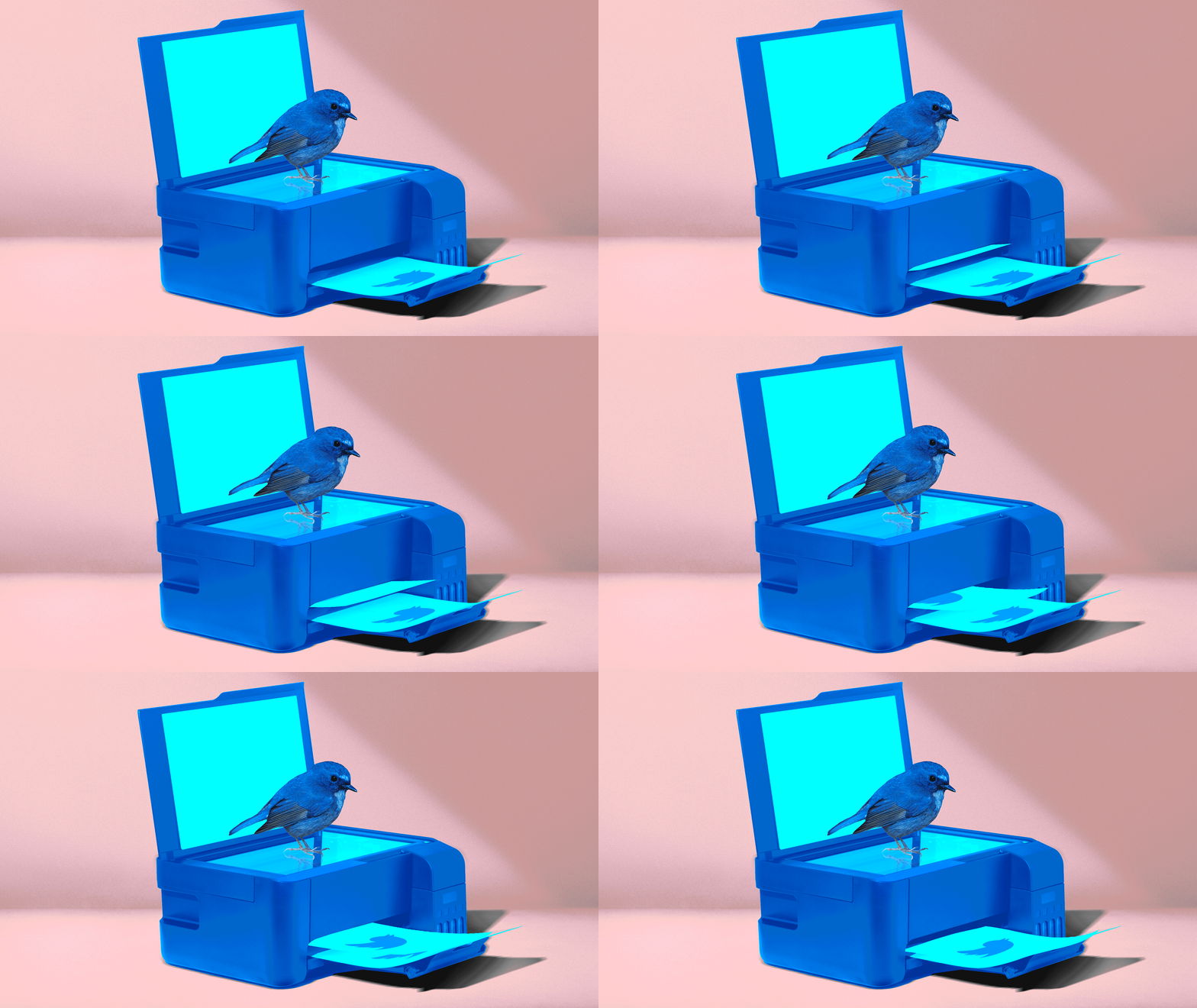 | | It's hard to keep track of all the Twitter alternatives that have popped up since Musk took over the company: Bluesky, Mastodon, Spill, Post, Notes and Artifact, just to name a few. Arielle talks to the latest copycatters behind T2, a platform trying to reinvent Twitter by recreating its (supposed) heyday. | | |  | | Earlier this spring, TikTok's Chinese parent company launched a campaign to bring creators to Lemon8—the firm's new platform that's best described as TikTok-meets-Instagram-meets-Pinterest-meets-Canva. Annie checks in with some of these social media celebs, who have mixed feelings about adding another platform to their oevre. | | |  | | As generative AI tools become more commonplace, a whole new specialty is emerging: the prompt whisperer. Chris Stokel-Walker talks to a few early movers within the booming prompt economy. | | |  | Noticing: Online dating somehow gets worse
Back in 2017, the year after I moved to San Francisco, I went out with someone I'd met on Tinder. The date was underwhelming, and we stopped seeing each shortly after. Turns out, you can never tell from on-app banter how you're going to vibe in real life. So imagine how disorienting the process has become now that people are turning AI chatbots into their own personal Cyranos. The Washington Post's Taylor Lorenz recently talked to online daters using AI to overcome the "mental work" of communicating on Hinge, Grindr or Bumble. One person credited an AI tool for creating conversation starters such as "What's your favorite dinosaur?" (If someone asked me that, I would immediately unmatch.) The demand for these tools suggests consumers have reached peak fatigue in online dating. I see this ending one of two ways: Either it forces people off the apps altogether, or it pushes them in further, until AIs are going on simulated dates, while the humans stay home and watch Netflix. Either way, the future of romance is chilling. —Arielle | | | Generating: Giant squid games
The premise for "The Kraken Wakes," a new indie PC game, seems straightforward enough: Mysterious objects have fallen from outer space into Earth's oceans, and you, an English Broadcasting Company reporter, are investigating a potential alien invasion. (It's based on a cult-favorite sci-fi novel of the same name from the 1950s, which itself is a reference to Tennyson's poem about a sea beast with "unnumbered and enormous polypi.") What's unusual about "Kraken" is how you go about looking into these Cloverfields: You spend a lot of time interviewing non-playable characters using a chat feature built on OpenAI's GPT-4, which sets up dynamic gameplay and unique outcomes for every player. The underlying software behind "Kraken" is not so much "a dialogue engine but…a listening engine," creator Guy Gadney explained to the Financial Times. "Our strength is the ability...[to] understand what you've said and then respond to that." Our response: release the krakens! —Abe | | | Reading: The reservation black market
About a year ago, I started following an Instagram account called ResX. The premise was simple: DM the account with any last-minute restaurant reservations you weren't going to use and watch them get snapped up by other followers via ResX's Stories—gratis. The donor avoids a cancellation fee; the taker gets a hard-to-book table. ResX is now a full-fledged app—one of many back-channel reservation tools taking hold in New York, where landing a competitive table is part social climbing, part extreme sport. Rachel Sugar at Grub Street enumerates the reservation resale market, which, to nobody's surprise, is both expensive and absurd. (I once asked a friend how she landed a table at 4 Charles Prime Rib. "The bots," she replied, eye-rolling at my obliviousness.) It's a market that only seems to be growing, making it ever harder to score a spot the old fashioned way—on Resy, obviously. —Annie | | |  | | Ay caramba! This week, we were all Ralph. | | | | Until next Weekend, thanks for reading. | | —Jon | | Weekend Editor, The Information | | | | | | | | | | | | |  | | | | Where Silicon Valley logs off. | | | | | | | | | | |



Comments